Deep-frying food production line process
With the continuous improvement of living standards, people have gained a new understanding of extruded puffed snacks, and demand has gradually increased. These snacks are crispy, delicious, sweet in taste, and convenient to eat, making them very popular among people, especially among children.The application of extrusion technology in the food industry has led to an increase in a wide variety of snack foods, baby foods, breakfast foods, and functional foods.Extrusion technology offers many advantages, and its processing produces unexpected effects.Although the food extrusion technology used in food puffing machines in China has not been around for long, it has been rapidly promoted and applied.After more than a decade of relentless efforts by researchers and engineering technicians, through the introduction of foreign technology, digestion, absorption, and bold innovation, various types of food extrusion equipment and their supporting products suitable for China's national conditions have been successfully developed. Food production enterprises are welcome to visit, inspect, and negotiate orders.
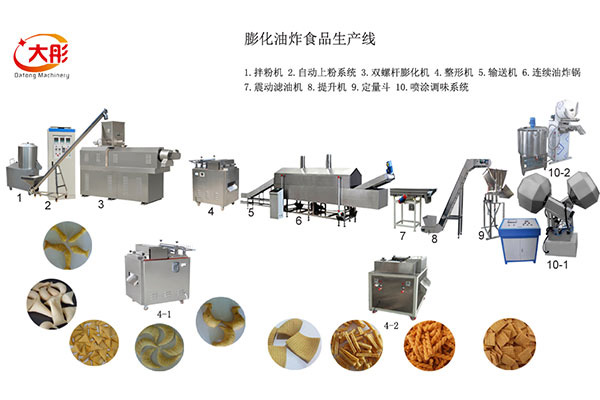
Puffed snacks are a widely used type of food. These foods are named direct-expansion from the extruder die and require no further processing except drying. Direct-expanded snacks include corn rings, crunchy nuts, onion balls, potato chips, and popular three-dimensional snacks.
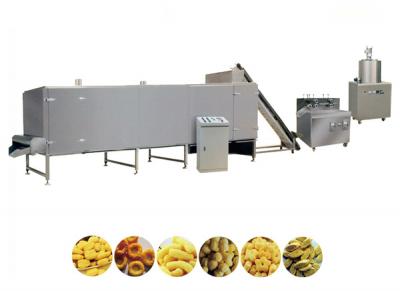
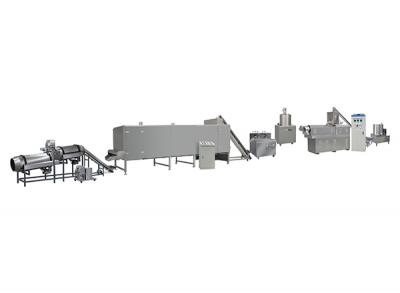
Puffed products have five processing sections: mixing → conveying → extrusion → drying → coating. 1. Mixing - its function is to mix dry materials uniformly and then combine with water to achieve a pre-wetting effect, providing some working time for starch hydration research. This process has a significant impact on the subsequent puffing effect. Generally, the total moisture content required for puffed materials is 13-20%, completed by a powder mixer.
2. Conveying - The mixed materials are conveyed from the hopper to the powder mixture. Long bucket elevators, screw conveyors, or vacuum conveying devices are commonly used.
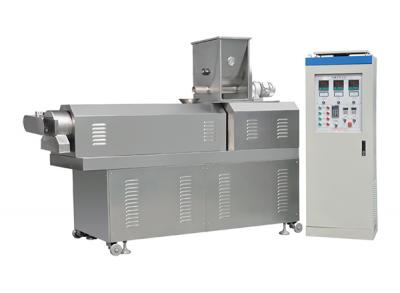
3. Extrusion – This is the key to extrusion puffing food processing. The extruder cooks the material information and, under a certain social pressure, transforms it into a plastic melt. The cooked material passes through small die holes under the influence of pressure to form a certain shape, and then expands upon being extruded from the die holes, resulting in the final shape. A cutting device cuts the continuous output into products of the desired size. The experimental operation device of the extruder can be used to manage and control the density and texture of directly puffed products. The processing parameters that need to be effectively controlled separately are moisture content, feed rate, barrel temperature, and screw speed (if the speed is variable). Die resistance is also a parameter that can be independently controlled, but it will no longer change during stable operation after the extruder is assembled.
4. Drying—Direct expanded foods generally undergo extrusion drying. The moisture content of the expanded raw material is 13-16%, which decreases to 8-12% as the moisture turns into steam and flashes off after extrusion. It is then further reduced to below 2-5% through drying, creating the crispy texture and stable shelf life required. Due to the low product density, the drying time is very short, achieving the desired effect.
5. Seasoning—Spraying with oil and seasonings. Seasoning agents give the product different flavors, and the oil and seasoning coating typically accounts for 20-35% of the finished product's weight.