Advantages of Twin-Screw Extrusion in Aquatic Feed Processing
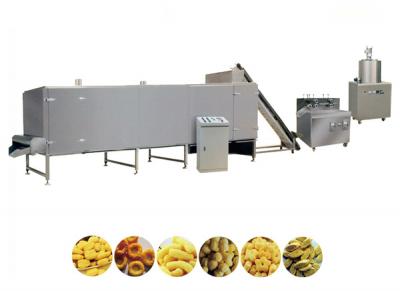
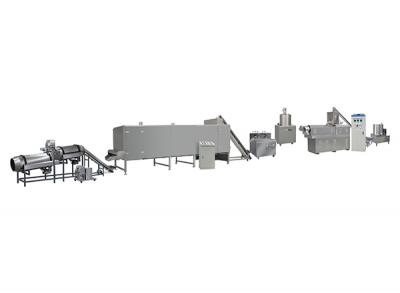
The twin-screw extrusion machine offers numerous advantages, including wider raw material adaptability, broader product applicability, better internal and external product quality, higher output under the same power, improved cooking and homogenization effects, simpler process operation, reduced wear on consumable parts, and lower production costs. These benefits provide feed processing enterprises with more compelling reasons to choose twin-screw extrusion machines when building or expanding production lines for specialty feeds such as aquatic feed and pet food.
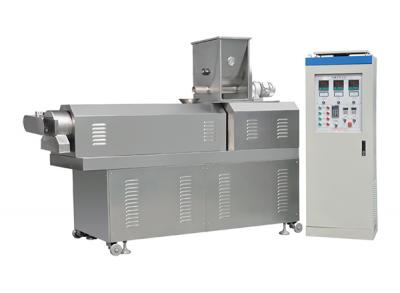
The single-screw extrusion expander has a simple structure, typically using a belt drive system with a fixed spindle speed that cannot be adjusted, resulting in low transmission efficiency and difficult process control. The screw of the single-screw extrusion expander consists of a shaft connecting various screw unit structures. The entire screw is composed of three sections: the feeding section, the kneading or melting section, and the forming section. After the material enters the barrel from the feed port, it undergoes solid conveying and melting processes within the screw, transforming from a loose state into a continuous, plastic dough-like mass. The twin-screw extrusion expander was developed based on the single-screw extrusion expander. In the barrel of the twin-screw extrusion expander, two screws are arranged side by side. Based on the relative positions and rotation directions of the screws, they are classified into non-intermeshing co-rotating, non-intermeshing counter-rotating, intermeshing co-rotating, and intermeshing counter-rotating types. The fully intermeshing co-rotating twin-screw extrusion expander significantly improves the material's conveying, pumping, and mixing characteristics.
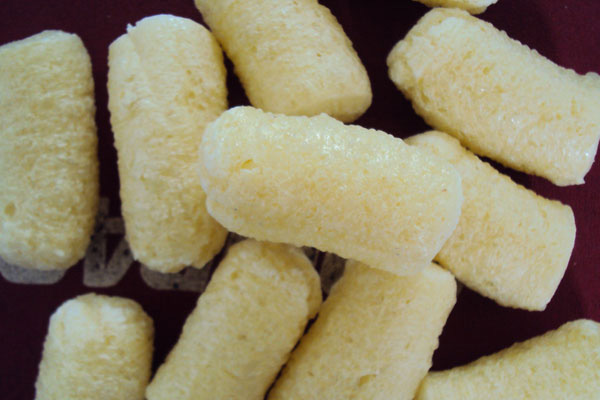
Advantages of twin-screw extruders: (1) Broader raw material adaptability, capable of processing high-viscosity, low-viscosity, high-fat content, high-moisture or sticky, oily, very wet materials, and others that may slip in single-screw extruders (SSE). (2) Less restriction on raw material particle size, accommodating a wide range of particle sizes from fine powders to coarse granules, as well as materials outside the specific particle size range for single-screw processing. (3) More uniform material flow within the barrel, allowing for more precise proportioning of steam, water, and other auxiliary processing aids to achieve desired effects. (4) Better internal and external product quality, achieving excellent homogeneity and uniform molecular structure distribution, resulting in smooth surfaces during extrusion, high product particle uniformity, and good consistency. (5) Improved gelatinization and homogenization, typically achieving starch gelatinization levels above 95%, ensuring that processed aquatic feed remains stable in water, retains nutritional content, and is easily digestible and absorbable. (6) Higher output under equivalent power, with good mixing properties enabling timely heat homogenization, accelerating material gelatinization, reducing temperature fluctuations, and increasing extruded product yield. (7) Greater product diversity and adaptability, capable of processing micro-pellet aquatic feed, high-oil formulations, high-moisture, high-binding products, as well as multi-colored, filled, and specially shaped items. (8) Simpler process operation, allowing adjustment of main shaft speed based on product requirements, and easy cleaning due to self-cleaning features without needing to disassemble equipment after each use. (9) Reduced wear on wear parts; a common misconception is that single-screw extruders experience less wear, but in twin-screw extrusion, stable material transport and flow characteristics result in less wear on the screws and barrel liners compared to single-screw extruders, and despite having an additional set of screws, the cost of wear parts remains lower. (10) Lower production costs, as twin-screw extruders offer stable operation, reducing material waste during startup, minimizing water and steam loss, lowering labor costs, improving heat transfer efficiency, increasing yield rates, achieving higher output per kilowatt-hour, and with lower wear part costs, overall production costs are significantly lower than those of single-screw extruders. (Source: Wang Mu, New Feed, 2007, (1): 37-41. Edited by anonymous author)