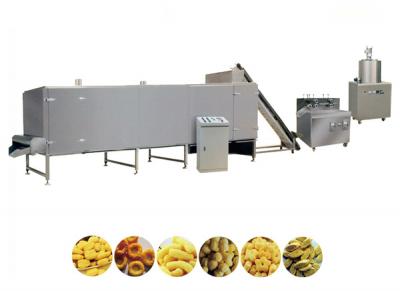
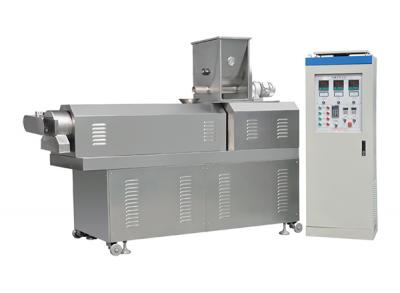
How to make corn puffed with a feed extruder
Since the 1990s, domestic feed extrusion technology has been widely developed, and the 160kw commercial model has been widely used. However, domestic feed extrusion technology started relatively late, with very weak basic research, and it is still in the process of imitation and improvement.It is at a stage.There are few reports about this.This article summarizes the new developments and applications of feed extrusion technology, providing a reference for the development of extrusion technology in China.1. New Developments in Extrusion Technology 1.1 Density Control System Density control is an important technical aspect in the production of extruded feed, especially in aquatic feed production.When sinking feed floats on the water surface, it not only reduces feed conversion efficiency but also wastes nutrients and pollutes the environment.Difficulties are even greater when using expansion technology to produce 'low-energy' sinking feed with relatively low oil content.Today, the common method in China is to expand the raw materials and then form them into pellets.Generally, product density can be controlled by formula adjustment and operating parameter adjustment.For example, reducing spindle speed, adding steam and water, increasing formula oil content, reducing supply and enhancing expansion chamber cooling, as well as some more effective measures.For example, using common methods (Wenger) to set up ventilation or decompression zones in the puffing chamber to increase the template opening ratio, change the template thickness, reduce the pressure difference on the template, and alter the structure of the puffing chamber.Adjust the recipe, especially by reducing the carbohydrate content.These measures play a role in controlling the degree of swelling, but are insufficient to produce settling feed in a controlled manner.Therefore, Sprout Matador developed a density control system for aquatic feed production.This is a major advancement in expansion technology in recent years.In the extruder, the material is subjected to mechanical shear forces as well as high temperature and pressure.Due to high pressure, the temperature does not reach the boiling point of water, but when the material is pushed out of the mold, it enters standard pressure, the boiling point appears, and water forms a 'flash evaporation'.
The material expands into a porous structure containing numerous pores, leading to changes in product density. The higher the carbohydrate content, the more pores are formed. High porosity means low density, and the material can float in water. For high-fat products, the porous structure promotes the absorption of sprayed oil (especially in the case of vacuum spraying) and results in a higher-density product. However, raw materials with medium and low fat content are more difficult to manage during production. The density system developed by Sprout-Matador uses pressure cutting technology to maintain a specific positive pressure in the cutting chamber. Since the boiling point of water increases with pressure, once the material enters the cutting chamber from the expansion chamber, the expansion of the material can be controlled by reducing flushing. The starch molecules in the feed extruder solidify instantly in the cutting chamber, so the material does not expand after reaching atmospheric pressure from the cutting chamber. The upper line in Figure 1 [1] shows the boiling point of water at different pressures, while the lower line shows the degree of product expansion at different pressures, with air pressure expressed in absolute pressure. The positive pressure in the cutting chamber is typically maintained at 0.03-0.20 MPa (Figure 0.13-0.30 MPa). Within this range, an increase in pressure has a significant effect on product expansion, but at 0.20 MPa (shown as 0.30 MPa), increasing pressure has almost no effect on product expansion. For example, for medium-fat sea, squid, and squid feed, a normal pressure reduction results in a 50% expansion rate (water boiling point 100°C). Increasing the pressure by 0.1 MPa, or increasing the positive pressure by 0.1 MPa, can reduce expansion by 50%. This means increasing product density from approximately 440 g/L to 550 g/L. This technology is mainly used for sinking feeds that are difficult to produce, such as low-fat products, and cannot apply positive pressure to oil-based products. Compared with other density control methods, such as open vent zones and decompression zones, this pressing method has technical advantages in producing products with special requirements.
If the product density can be precisely controlled (±5g/L), it is difficult to achieve through other means. Compared with open vents, the movement of the entire expansion chamber during production is almost unaffected by the material. Using low-fat or high-starch types of feed, the output of the extruder can be increased by 25% to 50%. There is no need to control other expansion factors, such as the structure of the screw and expansion chamber, or the feed rate. It reduces the need for manual operation. Since the degree of expansion is controlled outside the extruder, the operator only needs to monitor the visual quality of the product, and controlling the applied positive pressure is much easier than controlling the expansion chamber pressure. Household extruders basically have no density control device, and it is easy to improve the construction of the screw and puff chamber. Some products imitate Wenger's venting system, but due to technical and processing factors, they are less maneuverable. Pressurized cutting is relatively easy to achieve; an air pump can be used to maintain the required pressure, and the vent can be used to shut off the fan. Additionally, since the required pressure is not high, sealing of moving parts can be easily addressed. In terms of equipment manufacturing, operation, use, and density control of puff products, this technology is easier to implement than the venting type and represents a new direction for puff technology development. 1.2 Quenching and Tempering Technology Quenching and tempering technology is an essential step before puffing. Feed extruder Currently, domestic research on quenching and tempering is still very detailed, and there are single-shaft and dual-shaft types of products. The quenching and tempering described in this article actually involves pretreatment with waste steam. By redirecting the steam released from the "flash" of puffing and the hot air from the front of the cooler back to the conditioner, fuel consumption is reduced and decreased, and CO2 and SO2 emissions in the exhaust gas are reduced. At the same time, it is absorbed by odorous substances. Partial circulation of the cooling air can also reduce dust emissions. The environmental conditioner is equipped with steam at the extruder/expander outlet and hot air at the front of the cooler, so the material temperature can be raised from 20°C to 40°C without adding steam. This typically requires 2% steam. This is equivalent to saving 1.2 kg of fuel per ton of product, with corresponding reductions in CO2 and SO2 emissions (see Table 1). Compared with conventional pelleting, puffing produces products at 5kw? saving h/t.