Aquafeed mixing process and equipment
After the materials undergo crushing and batching processes, they need to be mixed. The mixing uniformity of the mixer is very important in feed processing, as it is a key factor affecting feed quality. Therefore, choosing the appropriate mixer is very important.
Mixers include horizontal, vertical, drum, and planetary types. Commonly used horizontal mixers are ribbon mixers, paddle mixers, and twin-shaft paddle mixers. Among these three types, the mixing uniformity of the twin-shaft paddle mixer results in a coefficient of variation of less than 5% for the material. In aquatic feed production, for mixing before grinding, where the requirement for mixing uniformity is not high, a ribbon mixer or single-shaft paddle mixer can be selected. For subsequent mixing with higher uniformity requirements, a twin-shaft paddle mixer is chosen.
The horizontal twin-shaft paddle mixer is a high-efficiency short-cycle mixer consisting of two rotors rotating in opposite directions. Multiple paddles at different angles are welded onto the rotors. These paddles not only drive the material to rotate along the inner wall but also cause the material to move left and right. At the intersection of the two rotors, an overlapping area forms a weightless zone. In this zone, regardless of the shape, size, or density of the material, it can float upward and enter a momentary weightless state, enabling the material to undergo continuous full-cycle flipping and mutual shearing. This achieves rapid blending and uniform mixing. Therefore, it is widely used in aquatic feed mixing processes.
Aquafeed mixing process and equipment
Due to the fine grinding of aquatic feed, there is significant moisture loss during processing (especially after micro-grinding and pneumatic conveying). Therefore, adding an appropriate amount of water during the mixing process is beneficial for pellet processing. However, the added water must be evenly distributed into the material in atomized form. Additionally, because the material particle size is too small, static electricity may be generated during mixing due to friction and other factors, which can affect mixing uniformity. Effectively grounding the mixer or adding anti-static agents such as vegetable oil can effectively solve this problem.
Vitamins, trace elements, medications, and other small-quantity additives in feed need to be premixed and gradually diluted to ensure uniform distribution before being directly poured into the feed mixer through the opening at the top of the mixer for blending. Generally, the premixing process in feed mills is relatively simple, but it requires high mixing uniformity, thus demanding higher standards for batching and mixing. Batching is typically done manually using electronic scales, and after batching, the ingredients are directly poured into the mixer for stirring. Common mixers used in premixing include drum mixers, planetary mixers, and twin-shaft paddle mixers. Vitamins, trace elements, medications, and other micro-ingredients can first be diluted in a drum mixer, and then further diluted with other components requiring premixing in a twin-shaft paddle mixer or planetary mixer.
Section 3: Aquatic Feed Pelletizing Process and Equipment
Pellet processing is a deep processing step in feed manufacturing. The design of the pelletizing process and the selection of related equipment are important factors affecting the quality of aquatic feed, including conditioning, pelletizing (or extrusion), pellet stabilization, cooling, and external liquid addition.
I. Conditioning
Conditioning is a processing procedure in which feed undergoes hydrothermal treatment to gelatinize starch, denature proteins, and soften the material. For aquatic feed (especially special aquatic feed), conditioning is particularly important due to the high requirements for water stability and digestibility. Conditioning typically includes pre-pelleting conditioning and post-pelleting conditioning (post-cooking), which can be used separately or together, and are often used together in aquatic feed.
1. Conditioning with a cylindrical conditioner
The cylindrical conditioner is a commonly used conditioner in feed mills. It controls conditioning by adding steam, adjusting the conveying speed of the paddles, and stirring. After steam is introduced into the jacket, it is used for heat preservation and heating. To enhance the conditioning effect, two or three double-layer jacket conditioners are often combined to extend the conditioning time, improve temperature regulation, and increase the starch gelatinization rate and protein denaturation degree of the feed, thereby improving feed quality. However, based on current usage, the cylindrical conditioner is not very effective. To strengthen the conditioning effect, we can make the following improvements:
(1) Change in the conditioner angle. Currently, cylindrical conditioners are usually installed horizontally, with a fixed motor speed, making it generally impossible to control the conditioning time. By adding a hinge and a device that can raise the conditioner at the rear, using flexible feeding and discharge ports, and replacing the reduction motor with a variable-speed motor (reducing the motor speed is also effective), almost arbitrary adjustment of the retention time can be achieved. Under normal operating conditions, the conditioner is horizontal. Once stable operating conditions are obtained, the conditioner can be tilted to extend the retention time to the desired requirement.
(2) Adjustment of the conditioner paddles: In the first third of the conditioning chamber, the paddles are set at a 45° angle to the shaft. The angle of the paddles in the latter two-thirds is appropriately adjusted to ensure the rear section of the conditioning chamber is nearly full, facilitating thorough mixing of the material while extending its retention time in the chamber.
(3) Installation of baffles: A relatively simple and effective measure for modifying the drum conditioner is the installation of baffles. The upper baffle prevents steam from escaping along the inner wall of the conditioner without contacting the material, while the bottom baffle acts as a plug to increase the material fill level in the conditioning chamber. In this case, residual issues must be carefully addressed, as 25–100 kg of material may remain in the conditioner after each operation.
2. Differential dual-shaft paddle conditioner conditioning
The differential dual-shaft paddle conditioner (referred to as DDC) with horizontally arranged shafts of different diameters features significantly longer conditioning time, with an average material retention time of 150–180 seconds; high starch gelatinization degree, reaching 40–50%; high liquid and fat addition ratio during conditioning, with material moisture content reaching 19–20%. It is commonly used in the production process of high-end aquatic feed such as shrimp and crab feed.
3. Expansion conditioning
It is actually a high-temperature, short-time conditioning method that primarily uses high temperature and pressure to increase the degree of starch gelatinization and protein denaturation, thereby improving the water resistance and digestibility of pelleted feed. Using expansion conditioning can reduce the requirements for raw material grinding fineness and variety, increasing production capacity while lowering feed formulation costs.
4. Stabilizer Conditioning (Post-Gelatinization)
After pelleting, the hot pellets directly enter the pellet stabilizer, utilizing their own heat and moisture, along with the insulation and heating effects of the jacket and steam inside the steam pipes, to further enhance starch gelatinization and protein denaturation inside and outside the pellets (especially on the pellet surface), thereby improving the water stability of the feed.
5. Steam Chest
The main function of the steam drum is to stabilize steam pressure and improve steam quality, which is very important in the conditioning process. To more effectively enhance steam quality, some staggered blades can be installed inside the steam drum to condense moisture from the steam.
2. Pelletizing
The design of the pelletizing process and the selection of related equipment are important factors affecting the quality of aquatic feed. Currently, equipment used for pelletizing includes hard pellet mills, extruders, and related equipment such as pellet coolers, crumbler rolls, and grading screens.
1. Hard Pellet Mill
Most aquatic feed is in the form of hard pellets, and the performance of the pellet mill has a significant impact on pellet quality. Compared to livestock and poultry feed pellet mills, aquatic feed pellet mills have the following differences: (1) The ring die compression ratio is larger. For ordinary fish feed, the compression ratio of stainless steel ring dies is approximately 11–13, while for alloy steel ring dies, it is about 9–11. For shrimp and crab feed, the compression ratio of stainless steel ring dies is approximately 21–25. (2) The rollers are changed from coarse teeth to fine teeth. (3) To increase output, the width of the ring die is increased. (4) The main motor is changed from four-pole to six-pole, with increased power. (5) The gear ratio inside the pellet mill gearbox is reduced. (6) The feeding speed is slower.
2. Extrusion Expander
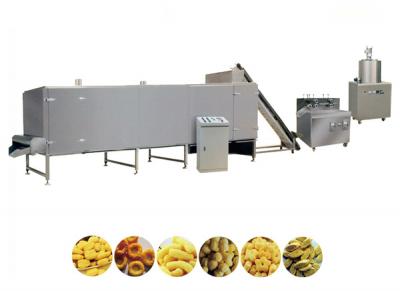
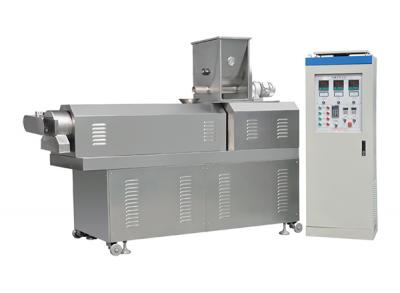
Currently, the main extrusion equipment used for production is the single-screw extruder, which can be further divided into dry extrusion and wet extrusion machines. Most extrusion equipment currently in use is designed for both dry and wet processing. By adjusting different parameters, the extruder can produce floating, sinking, slow-sinking, and semi-moist feeds, meeting the feeding requirements of various aquatic animals. However, due to the complexity of operation, high equipment costs, expensive maintenance, and high production costs, extrusion equipment is mostly used in the production of high-end aquatic feed. Additionally, the high temperatures generated during the extrusion process cause significant damage to heat-sensitive substances. For high-quality raw materials such as fishmeal and soybean meal, extrusion not only fails to improve digestibility and absorption but may even lead to a decline. Therefore, when producing sinking pellet feed, lower-quality raw materials can be extruded first and then pelleted using a hard pellet mill.
3. Pellet Cooler
The hot pellets after granulation undergo post-conditioning and enter the cooler for cooling. Since aquatic pellet feed has high requirements for water resistance, the cooling rate should not be too fast to avoid cracks on the pellet surface. The most commonly used cooling equipment in feed factories is the counterflow cooler, which provides good cooling effects. However, current cooler designs have not solved the issue of product moisture control, and most operators rely on experience.
4. Crumblizer and Grading Sieve
In principle, the use of a crumblizer should be avoided as much as possible in the production process of hard pellet aquatic feed, because crumbling affects the water resistance of the feed. Moreover, with the improvement of ring die manufacturing technology and pelleting technology, it has become possible to produce pellets with smaller particle sizes.
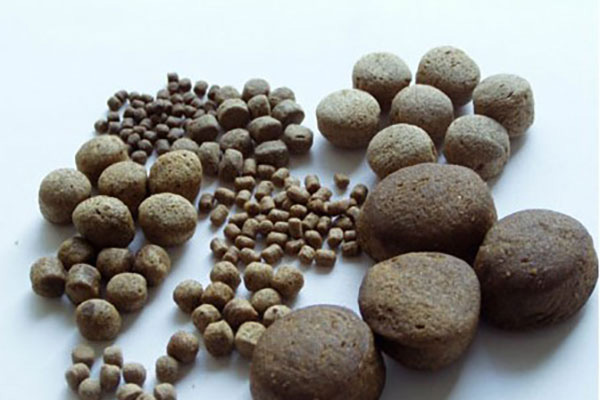
Pellets produced by an extrusion expander can be broken into smaller particles to meet the needs of juvenile aquatic animals, improve productivity, and reduce energy consumption. However, for aquatic feed crumbling machines, fine-toothed rollers should be used. Please refer to Table 1 for the particle size requirements of some common aquaculture species at different growth stages.
The grading sieve is mainly used to screen feed of the required particle size, and the selection of the sieve mesh can be determined based on needs. Rubber balls in the sieve should be made of elastic and wear-resistant materials to enhance screening efficiency and service life.
3. External Liquid Addition
1. Oil addition: Aquatic animals can utilize fat well, so the oil content in aquatic feed is generally high. However, the fat content in feed ingredients often fails to meet their needs, requiring additional supplementation. Oil can be added either before or after pelleting. For hard-pelleted feed, adding too much oil before pelleting can result in a loose product structure and poor water resistance, so it is generally controlled within 3%, with the remaining oil added after pelleting. For extruded pelleting, the full amount can be added at once without affecting the processing quality of the pellets.
2. Addition of heat-sensitive components. Aquatic feed generally undergoes processes such as enhanced conditioning, pelleting (or extrusion), and post-cooking during processing. In these processes, under the strong influence of temperature, moisture, and pressure, the activity of heat-sensitive components such as vitamins, enzyme preparations, probiotics, and drugs in the feed can be significantly damaged. To address this issue, post-addition processing is a good choice. Post-addition processing not only reduces the amount of heat-sensitive components added, lowering production costs, but also prevents cross-contamination of drugs and allows for flexible addition of trace heat-sensitive components according to customer requirements.
3. Liquid post-addition process
The oils and heat-sensitive components in aquatic feed are typically applied using spraying equipment, directly onto the surface of the pellets after cooling, which protects the active ingredients. However, since the cooled pellets do not absorb these components well, a large amount of oil and active ingredients adhere to the pellet surface, affecting flowability. When placed in water, some oil floats on the surface, polluting the water, while certain water-soluble components are lost in the water. To address this drawback, a new post-addition process—vacuum coating (also known as liquid penetration or core spraying)—has emerged. Its characteristic is ensuring the accuracy and uniformity of liquid spraying, significantly increasing the amount of liquid added, allowing trace components to penetrate into the interior of the pellets, thereby reducing the loss of trace components during use and oil pollution on the water surface. However, this process requires higher equipment standards and involves greater equipment investment.
In summary, the selection of aquatic feed processing technology and equipment can be flexibly chosen based on the cultured species, feed type, feed processing quality requirements, as well as processing costs, site conditions, and investment scale.