Application and Practice of Puffed Food Production
With the continuous improvement of people's living standards, people have gained a new understanding of the advantages of extruded puffed snacks, and the demand has gradually increased. Their crispy texture, sweet taste, and convenience have made them very popular, especially among children.The application of extrusion puffing technology in the food industry is increasing, with a wide variety of snack foods, baby foods, breakfast foods, and functional foods being introduced.The advantage of extrusion technology lies in its ability to provide many unique processing methods, producing unexpected effects.Although the application of food extrusion processing technology in China has not been long, it has been rapidly promoted and applied.Equipment manufacturers represented by Jinan Datong Machinery, after more than a decade of unremitting efforts by researchers and engineers, have successfully developed multiple types of food extrusion processing equipment and their supporting products that suit China's national conditions, based on the introduction, digestion, absorption, and bold innovation of foreign advanced technologies, and are highly welcomed by food production enterprises.This chapter focuses on the processing application practices of five typical extruded foods as a reference for those engaged in extruded food production.
I. Process and Equipment for Fully Expanded Leisure Foods
Fully expanded leisure foods are a widely consumed category of food. They are named for the direct expansion that occurs upon exiting the extruder die and require no further processing other than drying. Typical examples of direct-expanded leisure foods include corn rings, crispy puffs, onion balls, potato sticks, and the recently popular three-dimensional leisure foods.
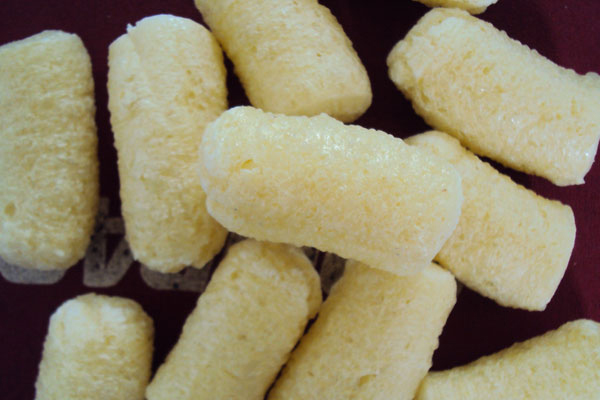
The processing of expanded products involves five stages: mixing → conveying → extrusion → drying → coating.
1. Mixing - Its function is to uniformly mix dry materials and then blend them with water to achieve a pre-wetting effect, providing some time for starch hydration. This process has a significant impact on the expansion effect. Generally, the total moisture content required for expanded materials is 13-20%, which is completed by a powder mixer.
2. Conveying - The mixed materials are transported from the powder mixer to the feed hopper. Bucket elevators, screw conveyors, or vacuum conveying devices are commonly used.
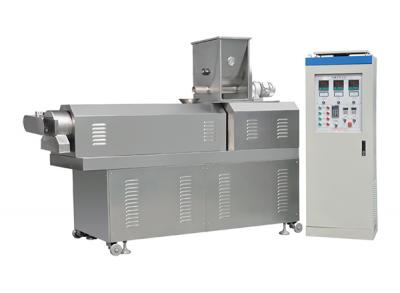
3. Extrusion - This is the key to extrusion puffing processing. The extruder cooks the material and transforms it into a plastic melt under certain pressure. The cooked material passes through small die holes under pressure to form a specific shape, and then expands as it is extruded from the die holes. The cutting device cuts the continuous output into products of the desired size. The operating device of the extruder can be used to control the density and texture of the directly expanded product. The processing parameters that can be independently controlled are moisture content, feed rate, barrel temperature, and screw speed (if variable). Die resistance is also an independently controllable parameter, but it will not change once the extruder is assembled and stabilized.
4. Drying - Directly expanded foods are generally dried after extrusion processing. The moisture content of the expanded raw material is 13%-16%, which drops to 8%-12% after extrusion due to the flash evaporation of water into steam. Subsequently, drying reduces the moisture content to below 2-5% to create the environment needed for a crispy texture and stable shelf life. Due to the low density of the product, the drying time required to achieve this effect is very short.
5. Coating - After expansion and drying, the product is coated with oil and seasoning. Oil gives the product a better mouthfeel, while seasoning imparts different flavors. The coating of oil and seasoning typically accounts for about 20-35% of the final product's weight.
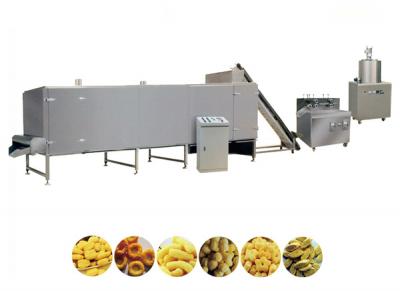
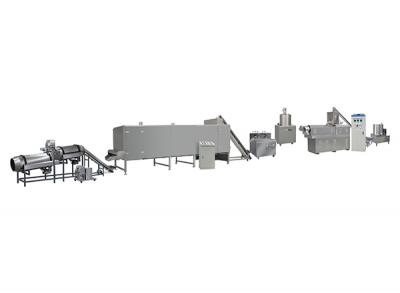
Taking the twin-screw extrusion snack food production line of Shandong Datong Company as an example, the production process of onion rings is introduced. Process route: batching → mixing → conveying → extrusion → baking → packaging. 2. Production process and equipment for fully expanded filled rolls (cakes)
The production technology of puffed filled rolls (also known as dual-extrusion technology) utilizes advanced extrusion puffing technology on single-screw or twin-screw equipment, using rice, corn, or other grains as raw materials and pure cream as the medium. Egg yolk powder, milk powder, sugar, sesame paste, chocolate powder, and other ingredients are diluted to form a filling material. As the puffed product is extruded, the filling is injected into the puffed grain food, resulting in a small filled snack. This food has a crispy texture and unique flavor. Depending on different processes and formulations, it can be processed into various nutritional foods, therapeutic foods, functional foods, etc. The application of puffing technology in food provides a new approach.
1. Grinding - Use fresh raw materials (corn, peeled) and grind to 20 mesh (for twin-screw use, grind to 60 mesh or above).
2. Mixing - Mix different raw materials and auxiliary materials evenly according to the proportion, and keep the moisture content of the mixed raw materials at 15-16% (adjust the moisture content of the materials for the twin-screw extruder to 18-20%). Experiments have shown that mixing rice and corn at a ratio of 5:1 yields good results.
3. Filling preparation - Due to its good stability, lubricity, and ability to impart a better flavor to the product, cream is an ideal carrier for the filling. Heat the cream to melt it, then cool it to around 40°C. Add various fillings in proportion (all added ingredients must be ground to at least 60 mesh) and stir evenly. To ensure product quality, add an appropriate amount of cream to ensure the mixture is evenly diluted and has good fluidity. (Use pure cream, without any added water).
4. Grain puffing and filling - This is the key process of this technique. The quality of the puffing directly affects the texture and mouthfeel. During extrusion, the material undergoes high temperature (approximately 130°C-170°C) and high pressure (5-10 atmospheres) to become a fluid gel state. It is uniformly and stably injected into the puffing roll through a specially designed filling die, extruded together with the puffed material. At the time of extrusion, the moisture content of the material drops to 9-10%.
5. Shaping and cutting - The strip-shaped filled material is guided to the entrance of a specially designed roll shaping machine. The shaping machine pulls the material, automatically completes and cuts it. The material is cut into rod-shaped filled rolls of uniform length and thickness. At this point, the material cools down, and the moisture content drops to 6-8%.
6. Baking - The purpose of baking is to improve the taste and shelf life of the product. Baking can partially cook the filling, producing a pleasant aroma. After baking, the moisture content of the raw materials is reduced to below 2-5%.
7. Mixing - The mixing chamber operates in a drum, including oil coating on the dough surface and seasoning spraying. Oil coating prevents the product from absorbing moisture, provides certain stability, and extends shelf life, while seasoning spraying improves taste and flavor. As the drum rotates, the material tumbles up and down, entering from one end and exiting from the other. The oil coating is applied when the material enters the drum. Through tumbling and mixing, the oil is evenly coated on the material surface. When the material passes through the middle of the drum, seasoning is added, and mixing continues. The product exiting the drum is the finished product. The product should have a uniform color, a pleasant golden yellow surface, and a beautifully smooth seal.
Main Equipment Configuration:
According to the process requirements of this production line, the following equipment needs to be configured:
1. Dough Mixer:
A. The rotary blade mixer is suitable for mixing and moistening 60-mesh raw materials, with a blade speed of 368 rpm and a batch mixing capacity of 10 kg (equipped with a single screw).
B. The drum mixer is suitable for mixing and moistening 20-mesh raw materials, with a speed of 35 rpm and a batch mixing capacity of 10 kg (equipped with a single screw).
2. Conveyor: Lifts the mixed material to the main hopper (manual feeding is also possible), with a conveying capacity of 0.5 tons per hour. The machine operates intermittently.
3. Extruder: Currently, the main machine used for producing filled snacks in China is the twin-screw extruder, which comes in two types based on structural design.
SLG65-III Fully Expanded Twin-Screw Extruder: This machine consists of a pair of intermeshing and co-rotating screws that work together to transport, friction, compress, and heat the material. The two screws stir, mix, shear, and compress the material during the conveying process, while external heating causes the starch to gelatinize and paste, raising temperature and pressure. The material expands through the die opening. The uniformity of expansion can be adjusted by changing the screw speed. The drive motor adopts advanced foreign frequency conversion speed control technology to ensure the reliability and economy of the equipment. This machine is easy to operate, clean, and switch between product varieties. It has high output, and the screw and barrel have a longer lifespan than single-screw extruders, but the processing cost is higher.
The screw and barrel are the core components of the extruder; their quality directly affects the extrusion quality of the product. It is essential to ensure that the screw and barrel operate in good condition. Since the screw and barrel rotate at high speed, the surface of the chromium steel material is hardened to improve its wear resistance and heat resistance.
4. Filling machine: Its function is to inject the mixed filling into the extruder mold through a screw pump, where the filling is wrapped by the extruded material and simultaneously extruded. The filling machine consists of insulation, stirring, and extrusion components. The filling is continuously stirred in the insulation tank to maintain good fluidity. The amount of filling can be controlled by adjusting the speed of the screw pump.
5. Multi-function shaping machine: The multi-function shaping machine consists of traction rollers and shaping roller cutters, with adjustable synchronous speed. The strip-shaped or ribbon-shaped extruded material from the main extruder is cut into specified lengths and dimensions by the multi-function shaping machine, and the filled roll blanks are processed in this step.
6. Elevator and dryer: The cut filled roll blanks fall into the elevator hopper and are directly conveyed to the dryer (tunnel-type oven). The drying temperature is set at around 170°C, and the material runs inside the dryer for 30 seconds, reducing the moisture content to below 2-5%. The dryer uses far-infrared heating, and the mesh belt speed is adjustable (via frequency conversion speed regulation).
7. Elevator and rotating drum: The material coming out of the dryer falls directly into the elevator hopper, then is lifted into the rotating drum. The front half of the drum has welded paddles around its circumference to allow the material to tumble, ensuring that oil is evenly coated on the surface of the material. The rear half has a smooth inner wall, where the filled rolls roll along the inner wall, allowing the seasoning to be evenly distributed on the surface of the material. The drum is tilted (the tilt angle is adjustable), and the residence time of the material in the drum can be controlled by adjusting the drum rotation speed.
8. Oil sprayer, seasoning machine, and conveyor: According to process requirements, the oil spray volume of the oil sprayer is adjustable, and the oil circuit consists of a gear pump, flow valve, and throttle valve. The seasoning machine uses screw conveying for long-distance material spraying, with adjustable conveying volume, and the seasoning bin has stirring paddles for continuous mixing to prevent arching. The conveyor is used to transport the finished product from the drum to the packaging machine. 9. Packaging machine: The packaging capacity of the packaging machine is designed based on the production line output.
III. Nutritional Rice Flour (Rice Flakes) Food Process and Equipment
Cereal flake porridge fast food is a typical example of the application of extrusion puffing technology, which has successfully revolutionized the manufacturing process of traditional fast food. Using extrusion puffing technology to process cereal flake porridge avoids many limitations of the old process, requires no expensive equipment investment or boilers, and features a continuous production process with no wastewater or waste. The multifunctional instant rice porridge production line developed by Saixin Company has a reasonable design, stable and reliable performance, high automation, and easy operation and maintenance. The main feature of this production line is that it greatly simplifies the traditional rice porridge production process. The cereal flake equipment designed with extrusion puffing technology can accept different materials and produce various shapes of cereal flakes. For example: corn flakes, rice flakes, millet flakes, oatmeal flakes, and flakes made from a mixture of two or more ingredients. This process can produce various popular instant nutritious oatmeal, corn, eight-treasure porridge, instant rice, nutritional granules, and other convenience foods on the market. This product is easy to use, does not become mushy after prolonged soaking, and has a smooth texture, making it an ideal food for family breakfasts and travel fast food.
Process Flow
Raw material crushing → Batching → Extrusion puffing → Granulation → Cooling → Tablet pressing → Drying → Direct packaging → Mixing with auxiliary materials and packaging equipment composition granulator
↓
Crusher → Mixer → Extrusion puffing machine → Air conveyor → Tablet press → Three-layer oven → Mixer and packaging machine IV. Process and equipment for one-time extrusion fried food. With consumers' increasing demand for novel and specialty foods, puffed food is a rapidly growing market. To meet market demands and the need for diverse production styles and processing convenience, our company has successfully developed a new potato deep-processing technology (also known as cold extrusion technology) based on absorbing advanced foreign equipment technology and considering China's national conditions. This is the third generation of puffed food.
The third-generation puffed food is another type of snack following the second-generation puffed food. Its production line adopts a unique extrusion molding process, giving the product an appealing visual appearance. The product has a natural and realistic shape with a fine texture. Precise parameter control and a complete process flow ensure stable product quality, a crispy texture that does not crumble or crack, combining traditional craftsmanship with modern technology. This technology primarily uses high-quality potato starch and potato flakes as raw materials, mixed in a specific formula ratio. These raw materials are rich in starch, which expands during puffing to form a network-like spatial structure, serving as the structural framework of the puffed product and giving it a certain shape. The raw materials are added to an extruder, where they are mixed, cooked, and gelatinized under specific temperature and pressure conditions. The material is then pressed through a specially designed mold to achieve the desired shape, and a rotating cutter with adjustable speed cuts the continuous extruded dough into the required length. By changing molds or using different cutting equipment, foods with flat, composite, or three-dimensional shapes can be produced. The next step is drying, where the dough is dried under specific temperature and humidity conditions to a moisture content of about 10%. This moisture level ensures that the dough achieves a puffed effect during frying. In fact, the dried dough is convenient for transportation and storage and can have a shelf life of up to about two years. Frying involves immersing the dough in vegetable oil at approximately 200°C for a few seconds, followed by seasoning the warm product to enhance its taste. To maintain the product's crispness for as long as possible, it must be immediately packaged in bags with high moisture resistance.
Extruded food products processed using cooling extrusion have better chewiness and texture compared to directly expanded products, and their oil content is much lower than that of fried potato chips, meeting the demands of today's consumers for healthy food.
Process Flow
Mixing → Extrusion forming → Primary drying → Secondary drying → Frying → De-oiling → Seasoning → Packaging equipment composition cooling tower
↓
Powder mixer → Extrusion puffing machine → Cooling air bed → Dryer → Frying machine → Seasoning machine → Packaging machine