What is the puffing principle of puffing machinery?
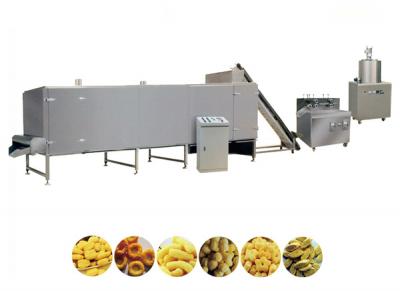
Puffing machinery is a processing equipment widely used in industries such as food, feed, and chemicals. Its core function is to rapidly expand materials under high temperature and high pressure through physical or chemical methods, forming a porous and loose structure. The puffing principle of puffing machinery involves knowledge from multiple disciplines such as thermodynamics, fluid mechanics, and materials science. Its core process can be summarized as 'rapid expansion under high temperature and high pressure conditions.' The following will elaborate in detail from aspects such as the puffing principle, equipment structure, process parameters, and applications.
I. Puffing Principle
The core principle of the puffing process is to utilize the physical and chemical changes of materials under high temperature and high pressure conditions, causing the internal moisture to rapidly evaporate and expand, forming a porous structure. Specifically, the puffing process can be divided into the following stages:
1. Heating and softening of materials
After the material enters the puffing equipment, it is first heated to a certain temperature by a heating device (such as electric heating wires, steam, or gas heating). During this process, components such as starch and protein in the material undergo thermal denaturation, gradually softening and forming a highly plastic state.
2. Moisture evaporation under high pressure environment
The material is subjected to high pressure inside the extrusion chamber, preventing the internal moisture from evaporating freely. As the temperature rises, the moisture gradually turns into steam, but due to the high-pressure environment, the steam is trapped inside the material, forming high-pressure steam.
3. Instantaneous Pressure Drop and Expansion
When the material passes through the outlet of the extrusion chamber, the pressure suddenly drops, and the high-pressure steam inside the material rapidly expands, causing drastic changes in the material's structure. At this point, components such as starch and protein in the material quickly expand under the action of the steam, forming a porous, loose structure.
4. Cooling and Setting
The expanded material comes into contact with the outside air at the outlet, rapidly cools and sets, forming the expanded product.
2. Composition of Extrusion Equipment
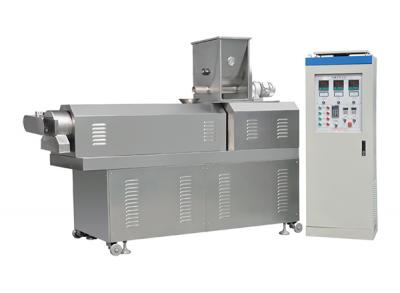
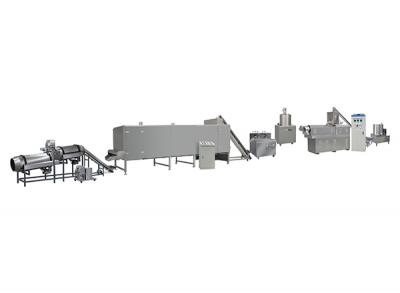
Extrusion equipment typically consists of the following main parts:
1. Feeding System
The feeding system is responsible for uniformly and stably conveying raw materials into the extrusion chamber. Common feeding methods include screw conveyors and vibratory feeders.
2. Heating System
The heating system provides the necessary thermal energy for the extrusion process. Common heating methods include electric heating, steam heating, and gas heating.
3. Extrusion Chamber
The extrusion chamber is the core part of the extrusion equipment, where materials undergo high temperature and high pressure to complete the extrusion process. The chamber is usually made of materials resistant to high temperature and high pressure, such as stainless steel.
4. Pressure Regulation System
The pressure regulation system is used to control the pressure inside the expansion chamber, ensuring that the material completes the expansion process under high-pressure conditions. Common pressure regulation devices include pressure valves, pressure reducers, etc.
5. Discharge System
The discharge system is responsible for expelling the expanded material from the chamber, as well as cooling and shaping it. The discharge method can be continuous or intermittent, depending on the equipment design.
III. Expansion Process Parameters
The quality of the expansion effect is closely related to multiple process parameters, mainly including the following aspects:
1. Temperature
Temperature is a key factor affecting the puffing effect. Too high a temperature may cause the material to scorch, while too low a temperature may not allow the material to puff fully. The suitable puffing temperature varies for different materials, typically ranging from 120°C to 200°C.
2. Pressure
Pressure is another important parameter in the puffing process. A high-pressure environment allows the moisture inside the material to fully convert into steam, thereby achieving violent expansion when the pressure is released. The pressure inside the puffing chamber is usually between 5 and 10 atmospheres.
3. Moisture Content
The moisture content of the material has a significant impact on the puffing effect. Excessive moisture content may prevent the material from puffing adequately, while too low moisture content may make the material overly dry, affecting the puffing effect. Typically, the moisture content of the material is controlled between 10% and 20%.
4. Residence Time
The residence time of the material in the puffing chamber also affects the puffing effect. Too short a residence time may prevent the material from puffing adequately, while too long a residence time may cause the material to char.
IV. Application of Puffing Machinery
Puffing machinery is widely used in multiple industries, mainly including the following aspects:
1. Food Industry
In the food industry, puffing machinery is used to produce puffed foods such as puffed rice, puffed corn, and puffed potato chips. Puffed foods are characterized by their crispy texture and easy digestibility, making them popular among consumers.
2. Feed Industry
In the feed industry, puffing machinery is used to produce puffed feed. Puffed feed has higher nutritional value and better digestibility, which can improve animal growth rates and feed utilization efficiency.
3. Chemical Industry
In the chemical industry, puffing machinery is used to produce materials such as puffed plastics and puffed rubber. Puffed materials are lightweight and porous, widely used in fields like packaging and insulation.
4. Pharmaceutical Industry
In the pharmaceutical industry, puffing machinery is used to produce puffing drug carriers. Puffing drug carriers have a large specific surface area and good solubility, which can improve the absorption efficiency of drugs.
The puffing principle of puffing machinery is based on rapid expansion under high temperature and high pressure, causing the moisture inside the material to evaporate quickly and form a porous structure. The core process includes heating and softening the material, moisture evaporation under high pressure, instantaneous pressure release and expansion, as well as cooling and shaping. Puffing machinery consists of a feeding system, heating system, puffing chamber, pressure regulation system, and discharge system. Its process parameters include temperature, pressure, moisture content, and residence time. Puffing machinery is widely used in industries such as food, feed, chemical, and pharmaceutical, providing important technical support for the development of related industries.