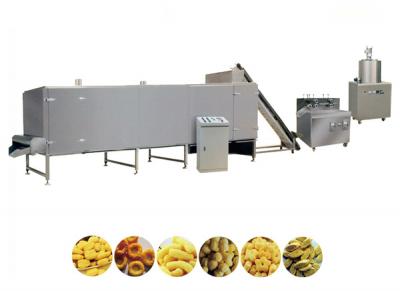
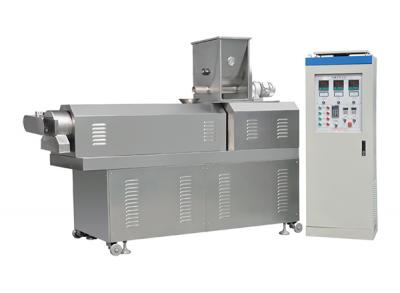
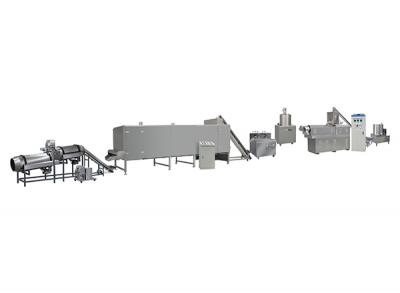
Operation and working principle of twin-screw wet feed extruder
I. Precautions Before and After Starting the Feed Extruder
1. Check all parts, especially the connections of each section of the extrusion chamber, the anchor bolts, the connection between the motor base and the frame, and the connection between the extrusion chamber and the frame. There should be no looseness.
2. Manually rotate the screw. At this time, there should be no scraping sound inside the extrusion chamber.
3. Start the feeding auger and check its stepless speed regulation performance. It should operate normally.
4. Before starting, check and clean the water and steam lines. All filters need to be cleaned.
5. Before starting the electronic control section, check whether the wiring is correct, whether each motor rotates correctly, and whether the control is reliable.
6. After shutdown, wear high-temperature gloves, quickly remove the discharge mold, the mung bean twist puffing machine, and clean it immediately while hot. Then start the main motor to empty the material accumulated inside the puffing machine shaft sleeve. When puffing corn, add soybean flour to flush and clean the material inside the cavity.
7. Pay attention to safety when disassembling the machine; no one should stand directly in front to avoid risks caused by residual pressure in the corn stick puffing machine cavity.
8. Once the equipment is running normally, do not stop it arbitrarily.
2. Startup
1. Before startup, check the fasteners to ensure there is no looseness.
2. Ensure the normal supply of steam and water.
3. Ensure the power supply and electrical equipment are normal.
4. Open the steam valve to preheat the puffing cavity to a temperature of about 100 degrees.
5. During normal startup, first start the conditioner, then start the feeding screw. After the material is conditioned, turn on the main motor, add a small amount of water to the extrusion chamber, and feed the material into the extrusion chamber. Once the material is extruded, adjust the expansion effect and moisture content of the product.
3. Shutdown
1. After a production phase ends (i.e., there is still material in the raw material warehouse) and shutdown is required, the stopping sequence is: feeding screw, conditioner. Then, when the host motor current indicator on the electrical control cabinet shows the no-load current value, stop the main motor and oil pump motor. (When extruding corn, approximately 25 kg of soybean powder should be fed into the bypass feeding port of the first extrusion chamber to clean the residual corn material in the extrusion chamber. Only then can the main motor be stopped to prevent clogging.) Immediately after, quickly disassemble the last extrusion chamber for cleaning. After cleaning, apply grease (feed-grade oil) to the inner walls of the main shaft and screw head, then reassemble and prepare for the next startup.
2. When the material level indicator on the bin shows that the material level has reached the low level, start preparing for shutdown. At this time, do not stop the feeding screw and conditioner. Wait until the main motor current drops to the no-load current, then stop the feeding screw and conditioner.
Working principle of extrusion puffing: The raw material is uniformly fed into the screw extrusion chamber by the feeder. The spatial volume of the extrusion chamber gradually decreases along the direction of material movement, causing the compressive force on the material to increase progressively. Meanwhile, during the movement within the extrusion chamber, the material undergoes intense shearing, kneading, and friction effects. Sometimes, auxiliary heating can be applied by installing electric heating plates outside the puffing chamber as needed, such as in livestock feed puffing machines. As a result of these combined effects, the material temperature rises sharply, and the starch in the material gelatinizes. The entire material transforms into a gel-like molten plastic. At the moment the material is extruded from the die holes, the pressure suddenly drops to 0.1 MPa (1 atmosphere). Water rapidly turns into steam, increasing in volume, causing the material volume to expand quickly. The water vapor further evaporates and dissipates, reducing the material's moisture content (generally by about 50%), while the temperature also drops rapidly. The material then begins to solidify, forming numerous micropores in the solidified gel structure. The continuous extrusion produces cylindrical or sheet-like puffed products, which are cut by a rotary cutter and cooled. Sometimes, post-processing steps such as drying and spraying additives (e.g., oils, vitamins, etc.) are also required.