Brown rice roll production equipment/food puffing machine/free trial machine available anytime with basic formula
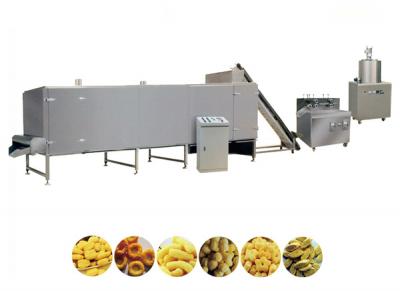
Brown rice rolls are a type of puffed food that is extruded into hollow, elongated puffed rolls using a puffing machine, with the hollow part filled with a core filling.Puffing makes food easier to digest and absorb.Puffing technology fully gelatinizes the starch, creating a porous internal structure, increasing water solubility, facilitating the penetration of gastrointestinal digestive enzymes, and improving the digestion and absorption rate of nutrients.The main ingredient of brown rice rolls is staple food. If additives can be reduced or omitted, it is not impossible for such food to become a staple. If the consumption method can imitate that of oatmeal or corn flakes, the market for brown rice rolls will undergo significant changes.The production equipment for puffed sandwich brown rice rolls completes the entire process from raw material mixing to finished product output in one go. It features a high degree of automation, uses simple and readily available raw materials, has low costs, and offers considerable profits, making it popular among small, medium, and large food manufacturers.
The production line features flexible configuration, a wide range of available machine models, easily obtainable raw materials, controllable costs, and simple operation. By changing molds and supporting equipment, it can produce products such as sandwich biscuits, sandwich tubes, sandwich rice crackers, wheat puffs, nutritious breakfasts, corn flakes, nutritious rice flour, and cereal porridge.
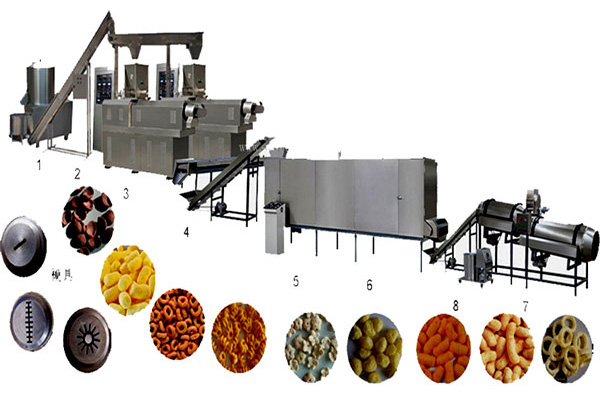
I. Process flow for puffed sandwich brown rice roll food production equipment:
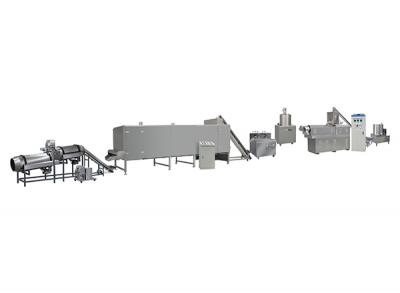
Raw material preparation → Raw material mixing → Conveying to feeding hopper → Extrusion puffing machine → Core filling injection → Shaping and cutting → Conveying → Drying → Oil spraying → Seasoning → Pillow packaging machine.
II. Configuration of puffed sandwich brown rice roll food production equipment:
Mixer → Feeder → Extruder → Filling Machine → Shaping and Cutting Machine → Elevator → Oven → Seasoning Line → Packaging Machine III. Sandwich Food Processing Equipment. Rice Cracker Food Machinery Process Composition:
A) Mixing machine: Mixes the main ingredients evenly, including corn starch, wheat starch, rice flour, bone meal, etc.
B) Screw conveyor: Transports the mixed ingredients via a screw to the extruder feed hopper.
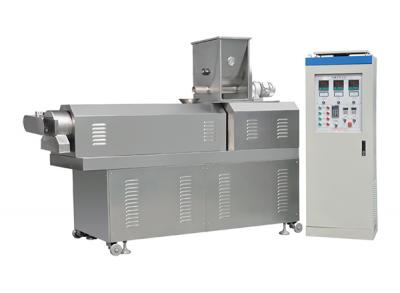
C) Twin-screw extruder: Selects different models of the main machine and related configuration equipment based on the customer's required output, extrudes the mixed materials through the extruder barrel, and cuts them into shape using the rotary cutting system.
D) Filling machine: Injects filling material instantly into the hollow tube produced by the extruder, such as peanut butter, chocolate sauce, syrup, etc.
E) Cutting and Shaping Machine: Cuts the filled rice snacks into pieces, with sizes adjustable between 2cm and 20cm as needed.
F) Elevator: Transports the rough rice roll snack after core material injection to the oven.
G) Multi-layer oven: The oven is basically an electric oven, with temperature adjustable between 0-200 degrees Celsius via the configured control cabinet. The interior features a stainless steel double-layer mesh belt for continuous circulation. The baking time can be automatically adjusted according to requirements. Through baking, the main material and core material are allowed to permeate to a certain extent, enhancing the taste, while also reducing the moisture content of the product to extend its shelf life.
H) Seasoning line: Includes octagonal drum, cylindrical drum, lifting single drum, and double drum seasoning lines, configured according to production volume and product characteristics. Additionally, there are oil spraying, sugar spraying, and coating equipment.
4. Equipment Quality Control:
1. Pre-production Design Control
Technicians design scientifically and reasonably based on the actual conditions and requirements of the customer's factory, power supply, location, etc., combined with equipment testing. Some equipment in this production line can be arranged at a 90-degree angle to save space and reduce costs.
2. Production Control
After the sales department receives an order, it submits it to the technical department, which produces the corresponding CAD drawings for the equipment based on the order details. The production department arranges for relevant parts to be procured, produced, and processed according to the CAD drawing technical documents.
3. Equipment and Spare Parts Acceptance
There are dedicated quality control personnel who conduct batch sampling inspections on purchased and outsourced parts. For critical and precision parts, quality inspections are carried out.
For self-manufactured parts, self-inspection, mutual inspection, and final inspection by processing personnel are required; only those that pass all inspections can be put into use.
After the finished equipment is installed, after-sales technical personnel will conduct acceptance inspection. The equipment must run idle for more than half an hour on site, and only after no faults are found can it be loaded for on-site debugging. Ensure that each piece of equipment meets factory conditions and issue an equipment certificate.
5. Company after-sales service commitment
1. Formula: The company's after-sales service personnel can provide relevant product ingredients and basic product formulas.
2. Training: On-site training for the relevant personnel of the buyer on equipment operation and regular maintenance.
3. Follow-up: Regular after-sales phone follow-ups with customers to help you solve related problems encountered during equipment use.
4. Maintenance: Our company provides the buyer with high-quality and low-cost spare parts year-round, and offers equipment upgrades and new product development support, truly giving you peace of mind.
5. Warranty Maintenance: In the event of equipment damage after the warranty period expires, upon receiving notification from the user, on-site repair will be completed within two days for users within the province. For users outside the province, the company will negotiate with technical personnel to arrive at the site as soon as possible. For out-of-warranty equipment, the company will charge for service and replacement of spare parts at cost.
6. Out-of-Warranty Maintenance: During the warranty period, if equipment damage is caused by non-human factors, the company will provide free repairs. For damage caused by human factors or force majeure, the company will provide repair services but will charge relevant fees.