Supply Datong floating fish feed extrusion machinery
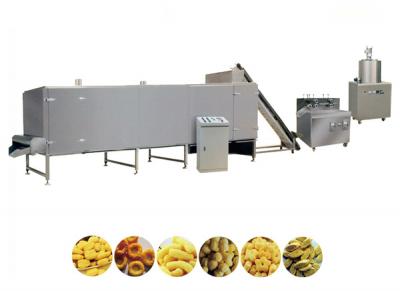
The floating fish feed production line is developed by Jinan Datong based on market demand and years of technical experience. It features stable output, guaranteed equipment quality, and a high degree of automation from bone paste to packaging. This production line can produce floating feed suitable for fish from fry to adult fish. The fish feed produced by this equipment is nutritionally comprehensive, easy to digest, highly absorbable, reduces sinking to keep feed floating on the water surface to minimize waste, and is suitable for producing feed with higher protein content. This feed equipment includes both wet and dry fish feed production lines.
I. Process flow of floating fish feed production equipment:
1. Material preparation: The main machine is a grinder, which grinds bones, minced meat, etc., into a bone paste state. Function: Provides raw materials suitable for extrusion in the extruder.
2. Ingredients: Weigh and prepare various raw materials for feed production according to the formula ratio. Function: The formula determines whether the fish will like the feed, making this step crucial.
3. Mixing: Place the prepared feed into a mixer for thorough blending. Function: Ensure even mixing of multiple raw materials. 4. Screw Conveying: Transport the mixed feed via a screw conveyor into the extruder's feeding hopper. Function: Screw conveying reduces waste during transport and adjusts the conveying speed based on production output.
5. Twin-Screw Feed Extrusion: The feeding hopper delivers raw materials to the extruder according to production output for extrusion and pelletizing. Function: The product's particle structure changes after high-temperature and high-pressure extrusion, making it more suitable for fish digestion and absorption.
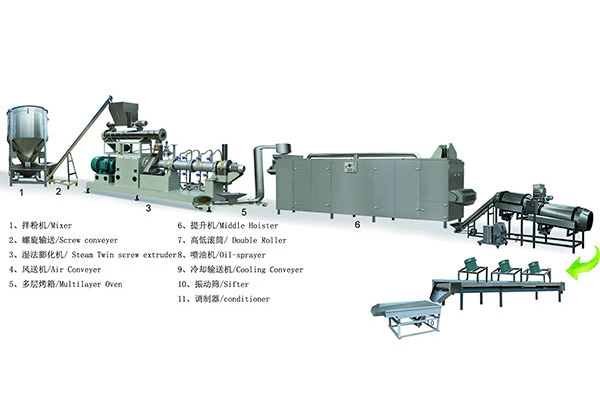
6. Air conveyor: Transports granular materials into the drying equipment using air speed. Function: Reduces manual material handling costs and is more hygienic.
7. Oven: Uses a reciprocating mesh belt to transport and dry granular materials to reduce moisture content. Function: Quickly dries the feed to extend shelf life.
8. Oil spraying: Enters the oil sprayer to spray oils or attractants. Function: Uses the sprayer to atomize the sprayed substance into a mist for more even application.
9. Seasoning: Adds seasonings and various additives to the granular materials through rolling motion. Function: Uses high and low rollers to roll back and forth, ensuring more even seasoning of the feed.
10. Cooling conveyor: Transports materials to the next step using fan blowing. Function: Reduces the surface temperature of the feed.
11. Vibration screening: The vibrating screen sifts particles through shaking, function: to make particles uniform and recover small particles to reduce waste.
12. Packaging: Weighing and packaging, function: to enhance the feed grade through exquisite packaging, making it more convenient and hygienic for customers to use.
2. Floating fish feed production equipment configuration:
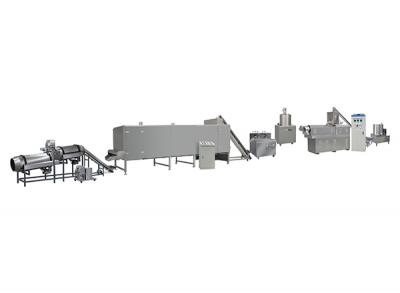
Bone grinder/pulverizer → Powder mixer → Screw feeder → Twin-screw feed extruder → Conveyor → Multi-layer drying equipment → Air conveyor → Oil sprayer → Flavoring line → Cooling conveyor → Vibrating screen → Packaging machine. This production line can produce fish feed sizes: 1mm, 1.5mm, 2.0mm-10mm.
This production line can produce and process aquatic feed pellets for catfish, grass carp, crucian carp, tilapia, ornamental fish, softshell turtle, bullfrog, and other aquatic species.
4. Process composition of floating fish feed production equipment:
Mixer: Thoroughly mixes raw materials such as corn flour, rice flour, soybean flour, fish meal, meat meal, grain flour, additives, and the required moisture according to the formula.
Feeder: Uses a motor-driven screw conveyor to transport the mixed raw materials to the feeding hopper of the twin-screw extruder. This equipment enables fast and convenient feeding, saves labor, and is highly efficient.
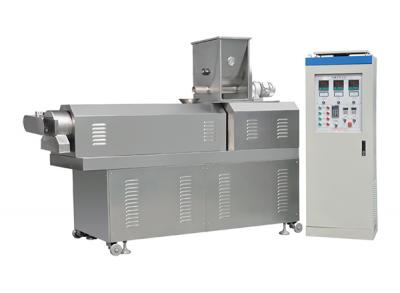
Twin-screw feed extruder: Under high temperature and high pressure conditions and the extrusion of the twin screws, the starch structure in the mixed raw materials changes, becoming easily absorbable nutrients. The material is extruded through a feed die, and by adjusting the rotation speed of the cutting motor, feed pellets of uniform size and length are produced. The specific pellet size and shape can be obtained by changing the die. The feed extruder adopts advanced variable frequency speed control technology, which is more energy-efficient and provides more precise speed control. The current and speed during motor operation can be directly viewed on the inverter panel, ensuring equipment safety.
Conveyor: Transports the produced feed pellets into the multi-layer drying equipment.
Multi-layer Oven: The oven is available in electric, oil-fired, gas-fired, and steam types, with temperatures ranging from 0 to 150 degrees Celsius, adjustable via the control cabinet. The interior features a stainless steel mesh belt for smooth transportation and low failure rates. Feed pellets circulate through multi-layer S-shaped tracks, drying them to a safe moisture content and extending shelf life.
Spray Seasoning Line: The oil sprayer applies oils, attractants, etc. The seasoning drum comes in octagonal, cylindrical, single-drum lifting, and double-drum seasoning line configurations, configured based on output and product properties. It sprays oil onto the feed surface while evenly distributing minced meat and spices. This process also removes burrs and rough edges from the feed pellet surface, making it smoother.
Cooling conveyor: reduces the surface temperature of dried feed pellets, promotes fat solidification, lowers pellet temperature, and facilitates packaging.
Vibrating screen: removes excess scattered material and pellet debris, ensuring quality while enabling raw material reuse.
Packaging machine: manual sealing machines and automated packaging machines are available; for details, please contact the manufacturer.
Floating fish feed processing equipment --- Equipment quality control:
1. Preliminary design control of equipment
Technical personnel carry out scientific and reasonable design based on the actual conditions and requirements of the customer's factory, power supply, location, etc., combined with equipment testing conditions.
2. Standard for selection of spare parts
Suppliers of spare parts are strictly selected for their products, choosing manufacturers with high quality and competitive prices in the industry.
3. Production control
After the sales department receives an order, it submits it to the technical department, which produces the corresponding CAD drawings for the equipment based on the order details. The production department arranges for relevant parts to be procured, produced, and processed according to the CAD drawing technical documents.
4. Equipment and Parts Acceptance
There are dedicated quality control personnel who conduct batch sampling inspections on purchased and outsourced parts. For critical and precision parts, quality inspections are carried out. For self-manufactured parts, self-inspection, mutual inspection, and final inspection by processing personnel are required, and they can only be put into use after passing all inspections. After the finished equipment is installed, after-sales technical personnel conduct acceptance checks. The on-site equipment is run without load for more than half an hour, and only after no faults are found can it be loaded for on-site debugging. Ensure that each piece of equipment meets factory delivery conditions and issue an equipment certificate of conformity.
Floating fish feed production line, fish feed production line, extruded fish feed production line, ornamental fish feed production line, floating fish feed production line, floating fish feed production line, floating fish feed production equipment, extruded feed machinery, extruded feed processing equipment, catfish feed production line, tilapia feed processing equipment, carp feed processing machinery, tropical fish feed production line