What are the advantages of the fish feed production line
As China's aquaculture industry develops towards a professional and large-scale direction, significant progress has been made in the research and production of aquatic feed. In recent years, with the enhancement of China's feed industry's research and development capabilities, further improvement in feed production technology, coupled with the introduction of advanced foreign feed processing equipment and production techniques, extruded aquatic feed has emerged prominently. With its unique advantages, it has increasingly gained favor among aquaculture enterprises and farmers, trending to replace traditional pellet feed.
The concept of extruded feed production technology, feed extrusion machinery, the advantages and disadvantages of extruded feed, as well as its application in aquaculture production, existing issues, and suggestions for future steps, are briefly introduced and analyzed.
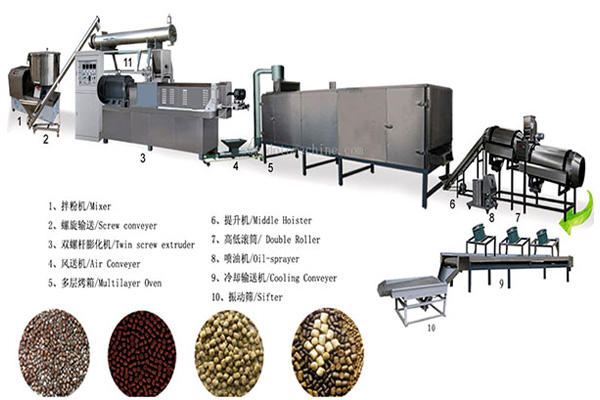
First, the concept of extrusion puffing is well-known. It is a forming process involving a set of high temperatures and pressures followed by mixing, shearing, heating, kneading, cooling, and other processes. This process involves decompression treatment of the material, where pure water instantly evaporates, using the material's own expansion characteristics to alter certain properties of the material through processing techniques. Early extrusion technology was mainly applied in the food processing industry. In the 1950s, the United States began using it in the feed industry. Since the 1990s, China has also seen significant expansion of this technology, with the livestock, aquaculture, and high-end feed production sectors basically adopting puffing treatment.
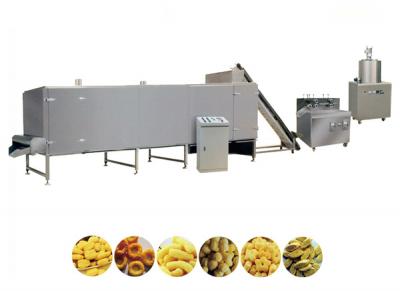
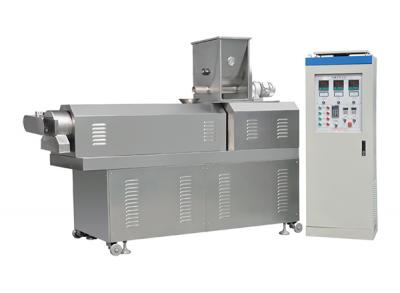
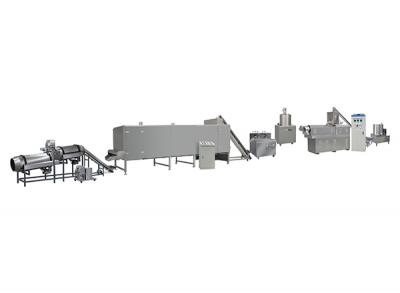
Second, the production process and equipment for extruded aquaculture feed are relatively simple. The general process of extruded aquatic feed involves grinding raw materials, followed by cleaning, then mixing them in a certain proportion, adding fine grinding to the conditioner for steam or water conditioning for 5 minutes. After conditioning, the material reaches a predetermined initial solidification and is then placed into an extruder. Under the action of heating, pressure, and mechanical shear, the material becomes viscous and moves forward as a granular amorphous substance through the rotation of the screw. A certain discharge pressure behind the die causes the material to be extruded from the extruder into a lower-pressure atmosphere through the die holes. The high-temperature material immediately causes evaporation and expansion upon contact with water. The external rotation cuts the product to a predetermined length and segments the rear end of the cutting die extrusion. Then, through baking, the moisture content drops to 9% to 12%, followed by further fractionation, coating, and packaging. In addition to these basic processes, heat-sensitive components in extruded feed processing involve adsorption, addition, and other post-treatments to reduce their loss. Extrusion plays a very important role in the expanded feed production process, significantly affecting feed quality and production efficiency. The main equipment for the extrusion process is the extruder, which essentially consists of a machine, a rotating screw, and other components. Single-screw extruders and twin-screw extruders are two types used in actual production. Single-screw extruders have a relatively simple structure, lower cost, older age, and more mature technology, mainly used for producing low-grade feed. Twin-screw extruders are multi-screw extruders developed based on single-screw extruders, offering advantages such as extrusion adaptability, material delivery, and self-cleaning. However, they have a complex structure, high investment costs, and relatively higher maintenance and operation costs. They are typically used for producing high-value aquatic animals and pet food. However, with the development of the aquaculture industry and the increasing demand for aquatic feed, twin-screw extruders will be widely applied.
Third, the fluctuations in the relationship between aquaculture and the density of aquatic feed vary according to the different reproductive habits of the target species. Extruded feed needs to exhibit different fluctuation characteristics to better meet the diverse feeding requirements of the cultured species. The significance of controlling fluctuations lies in ensuring the nutrition of farmed animals, maintaining a good water environment, and improving the utilization rate of aquatic feed. The fluctuations in UPS and aquatic feed are determined by density. Here, bulk density refers to the density of different feed pellets, which is the actual density of the feed product. Taojian Fang (2006) reported that the general relationship between the density of pelleted feed and the bulk density of feed products is as follows: density = bulk density of feed pellets / (1 - porosity). Many factors affect feed density, such as processing equipment, processing parameters, process control, feed ingredients, formulation, etc.
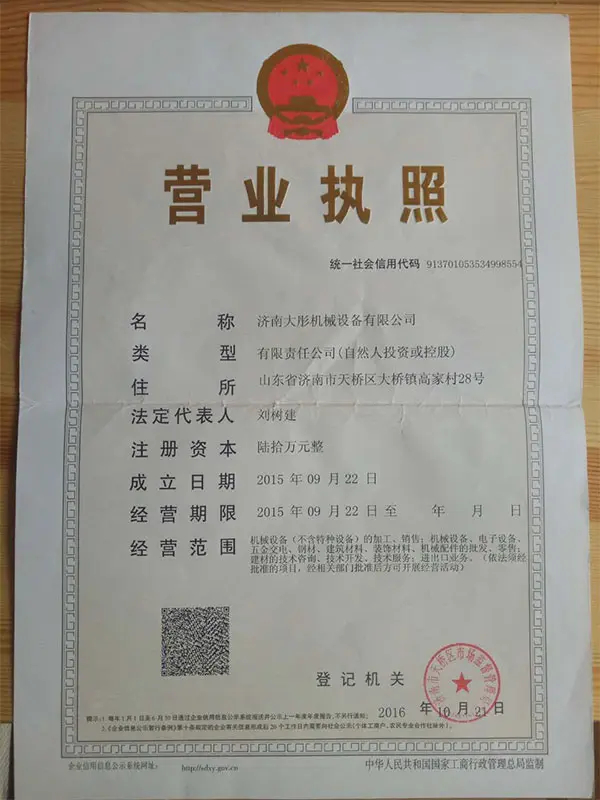
Jinan Datong Mechanical Equipment Co., Ltd. directly supplies various models of fish feed production lines, shrimp and crab feed production lines, aquatic feed production lines, pet feed production lines, dog food production equipment, and other feed extrusion machinery to the market and factories year-round. Welcome to inquire and place orders.