Analysis and Selection of Aquatic Feed Extrusion Machine
Currently, most feed mills in China use ring die pelleting to produce aquatic feed.Hard pellet feed produced by ring die pelleting sinks to the bottom of the water and disintegrates within 10 to 20 minutes, resulting in poor palatability. Some residues remain in the aquatic environment, causing severe water pollution. In contrast, extruded feed, processed under high temperature and pressure, is a high-quality, environmentally friendly feed with low pollution, minimal waste, and high conversion efficiency.Therefore, aquatic extruded feed has gradually become the mainstream trend in aquaculture feed, replacing hard pellet feed.The production process of aquatic extruded feed generally includes steps such as raw material grinding, mixing, secondary micro-grinding, extrusion puffing, drying, and cooling. Among these, extrusion puffing plays a very important role in the entire process and has a significant impact on feed quality and production efficiency.Therefore, this paper discusses the working characteristics and rational selection of single-screw and twin-screw aquatic feed extrusion expanders, providing a reference for manufacturers to correctly apply aquatic feed extrusion expanders, so that extrusion technology can truly play a role in production, achieving the goals of increasing production, reducing consumption, and improving nutrient digestibility and energy utilization during feeding.
Structural Characteristics and Working Principle of Extrusion Cooker
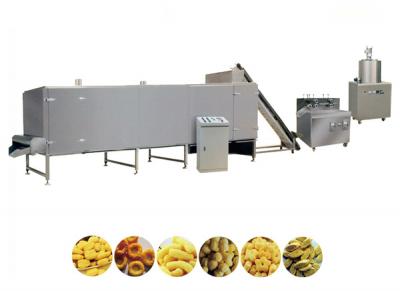
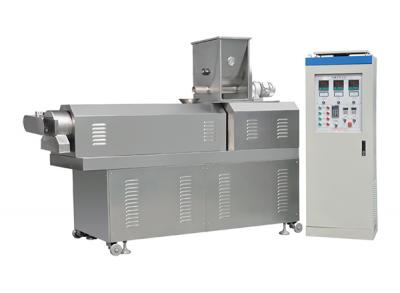
The extrusion cooker mainly consists of a barrel and a rotating screw inside the barrel, and is classified into single-screw and twin-screw extrusion cookers. During the extrusion process, the material enters the die cavity from the feed port and is pushed forward by the screw, undergoing compression, mixing, compression, and shearing. Due to the effects of driving force, friction, shear force, and external heating, the material is pressurized and heated, reaching a high-temperature, high-pressure state and becoming a modified paste. When the material is extruded from the die holes at the front, the sudden drop in temperature and pressure to normal levels causes rapid vaporization of moisture inside the material, leading to rapid volume expansion and forming a puffed product.
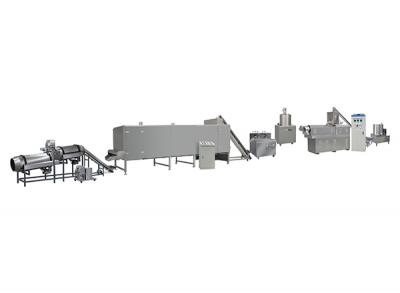
Aquatic Feed Extrusion Machine
1.1 Single-Screw Extrusion Cooker
The screw of a single-screw extrusion cooker is composed of a shaft connecting various structural screw units. The entire screw consists of three sections: the feeding section, the kneading section, and the melting and homogenizing section. After the material enters the barrel from the feed port, it undergoes solid conveying, melting, and homogenization processes within the screw, transforming from a loose state into a continuous, plastic dough-like mass.
In a single-screw extrusion chamber, the material is basically tightly wrapped around the screw in a continuous spiral带状 form. When the screw rotates, the material moves forward along the spiral like a nut. However, if the friction between the material and the screw is greater than the friction between the material and the barrel, the material will co-rotate with the screw, preventing the forward extrusion and conveying of the material. The higher the moisture and oil content of the material, the more pronounced this trend becomes. To avoid these issues, most modern single-screw extrusion cookers adopt a segmented design with single and double screws, a combination of pressure rings and kneading rings arranged alternately, and a grooved inner barrel to adapt to changes in the material within the chamber.
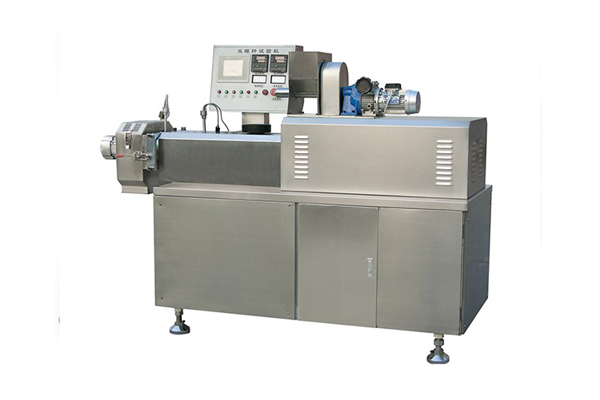
The single-screw extruder has a relatively simple structure and a relatively low price. It was developed earlier, with relatively mature technology and stable equipment. It has been used as the main equipment in extruded aquatic feed production for over 40 years and is widely applied in the production of low-protein adult fish feed for tilapia, catfish, grass carp, and common carp. Additionally, in the production of low-grade feed such as pond polyculture fish feed, the single-screw extruder has obvious advantages. Its raw materials do not need to undergo ultrafine grinding, and a particle size of 95% passing through 30–50 mesh is sufficient, which significantly reduces equipment investment costs and improves production efficiency.
1.2 Twin-screw extruder
The twin-screw extrusion cooker is a type of multi-screw extrusion cooker developed from the single-screw extrusion cooker. In the barrel of the twin-screw extrusion cooker, two screws are arranged side by side, hence the name twin-screw extrusion cooker. Based on the relative positions of the screws, they can be classified into intermeshing and non-intermeshing types, with the intermeshing type further divided into partially intermeshing and fully intermeshing types, as shown in Figure 1. According to the direction of screw rotation, they can be classified into co-rotating and counter-rotating types, with counter-rotating further divided into inward and outward types, as shown in Figure 2. In the co-rotating twin-screw type, the pressure zones differ in nature. Under the rotational action of the screws, the material inside the barrel cavity generates high-pressure and low-pressure zones, as indicated by the symbols '+' and '-' in Figure 3(a). It is evident that the material flows from high-pressure zones to low-pressure zones in two directions: one is along the inner wall of the barrel, forming left and right C-shaped material flows following the screw rotation direction (see Figure 4), which is the main flow; the other is through the gaps in the intermeshing part of the screws, forming a counterflow [see Figure 3(b)]. The reason for the counterflow is that the left screw pulls the material into the intermeshing gap, while the right screw pulls the material out of the gap, causing the material to advance in an '∞' shape and changing the flow direction. This not only facilitates the mixing and homogenization of the material but also generates grinding (i.e., shearing) and rolling effects between the screw flights, resulting in a calendering effect, which is much smaller compared to the calendering effect of counter-rotating screws. Of course, a smaller calendering effect also reduces the wear of the material on the screws. In this way, the material undergoes conveying, shearing, mixing, and heating by the barrel shell, achieving maturation under high temperature and high pressure before being extruded out of the barrel.
The counter-rotating twin-screw extrusion cooker generally uses two screws of identical dimensions but with opposite thread directions. The difference between inward and outward rotation lies in the position of the pressure zone. Inward rotation of the twin screws generates higher pressure at the top and lower pressure at the bottom. When the material passes through the twin screws, high pressure is created at the inlet, making feeding difficult. Currently, this inward counter-rotation type is rarely used. Outward rotation of the twin screws generates lower pressure at the top and higher pressure at the bottom, which facilitates feeding. However, compared to co-rotating twin screws, the C-shaped material flow formed by the material in the screws during counter-rotation cannot transfer from one screw to the other, significantly reducing the degree of mixing. Additionally, its self-cleaning ability is not as effective and stable as that of co-rotating twin screws.
Due to the pressure difference between the upper and lower sides of counter-rotating twin screws, a separating force F is generated that pushes the screws outward. Under the action of F, the screws press against the barrel, accelerating the wear of both the barrel and the screws. The higher the rotational speed, the greater F becomes, and the more severe the wear, thereby limiting the screw speed. In contrast, co-rotating twin screws do not experience a force that separates the two screws, resulting in less wear, allowing for high-speed operation and achieving high output. Therefore, co-rotating twin screws are more widely used.
The heat source required for the material, aside from the part shared with the single screw, mostly comes from the meshing gap; subjected to the shearing, squeezing, and mixing of the intermeshing threads, heat is generated and homogenized. The size of the gap significantly affects the extrusion quality—a smaller gap increases shear force but reduces the amount of material passing through; a larger gap increases the material throughput but decreases shear force. The forced conveying and self-cleaning characteristics of the twin screw ensure a short and uniform residence time of the material in the barrel; the excellent mixing performance of the twin screw allows the heat received by the material to be promptly homogenized, accelerating the material's cooking degree, reducing fluctuations in material temperature, and improving the yield and quality of the extruded product.
The twin-screw extrusion expander offers advantages such as strong adaptability, slip conveying, and self-cleaning, but its complex structure leads to high investment costs, as well as relatively high maintenance and operation costs. Therefore, twin-screw extrusion expanders are generally used in the production of high-value-added aquatic and pet feeds, such as eel, turtle, and juvenile fish feed, because the market prices of these products are sufficient to justify the costs associated with twin-screw technology. Additionally, certain specialty aquatic feeds, such as micro aquatic feed (with a diameter of 0.8–1.5 mm), high-fat aquatic feed, and feeds with small production volumes but frequently changing formulas, also require the use of twin-screw extrusion expanders for production.
The development of twin-screw extrusion cookers in China started relatively late. For medium and large twin-screw extrusion cookers, due to the wide variation in raw material characteristics, the screw speed needs to be adjusted over a broad range. Since their working principle differs from that of single-screw extrusion cookers, there are significant structural differences, especially in the arrangement of the barrel, screw, thrust bearing, and gearbox, which increases equipment costs. A comparison between co-rotating twin-screw extrusion cookers and single-screw extrusion cookers under the same production capacity is shown in Table 1.