Changes in Corn Starch During Extrusion Puffing in Puffed Feed Machinery
What is the process of the impact on starch structure during the extrusion of expanded feed machinery.
About 70% of the components in corn kernels are starch, so changes in starch are the main factor affecting the characteristics of extruded expanded feed (expanded feed machinery). During the extrusion and expansion process, starch undergoes two main changes.
One is starch gelatinization, the essence of which is that water enters the microcrystalline bundle structure, breaks the association between starch molecules, and the starch molecules or their aggregates become highly hydrated to form a colloidal system.
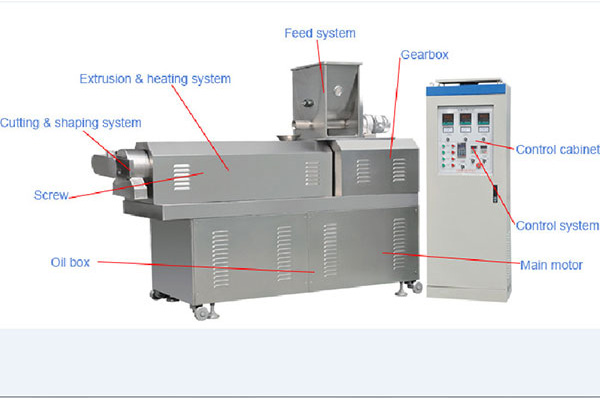
On the other hand, starch degradation occurs under high temperature and high shear conditions, where starch chains are partially broken, leading to the formation of small oligosaccharides (producing maltose, dextrin, and other small molecules). The mechanism of starch gelatinization in extrusion processing differs significantly from conventional starch gelatinization. Conventional starch gelatinization is a gradual process in which, under conditions of excess water but without external forces (such as pressure or shear), starch granules absorb water and swell upon heating, starting from the amorphous region until the crystalline structure disintegrates and polarized light birefringence disappears. In conventional gelatinization, if the moisture content of starch granules is below 30%, even heating to relatively high temperatures can only partially melt the microcrystals. In extrusion processing, under the combined effects of high temperature, high pressure, and high shear, hydrogen bonds between starch chains break, transforming the starch from a compact and ordered structure into a loose and disordered one. During extrusion, an increase in moisture content significantly reduces the degree of starch gelatinization, with the effect being more pronounced at high moisture levels (>23%).